If you’re from Cleveland, you have probably asked, or have been asked: “What are you?” This question – a common one to Clevelanders – must be considered odd or just plain rude to most people. To a Cleveland native, however, the question translates much differently. It simply means “What is your nationality or ethnic heritage?”
Why might a Clevelander consider this at all important? The answer lies of course in our city’s history.
In the last 150 years, Cleveland experienced a massive flood of European immigration. These immigrants were often fleeing desperate conditions at home and/or seeking sustainable employment abroad. Cleveland, which would become the fifth largest city in the U.S. as well as an industrial powerhouse, became a magnet, and eventually, a haven for these hopeful newcomers. In no time the city evolved into an aggregation comprising dozens of nationalities. Today, fully 75% of greater Cleveland residents are descendants of these immigrants, and the city’s identity remains closely tied to its unique ethnic heritage.
One of the largest ethnic populations in Cleveland is represented by the Irish. Almost 20% (approximately 410,000 people) of greater Cleveland residents are of Irish descent. Many of their ancestors immigrated to America in response to the Irish potato famine in the 1840s. In fact, almost one quarter of Ireland’s total population eventually immigrated to the U.S. These immigrants were able to scrape together their meager savings to purchase passage here, and many travelled on cramped “coffin ships” which provided little food and water and tended to spawn illness and disease. More than a few did not survive the journey. Those who did relocated in cities that offered plentiful employment, albeit menial jobs with miserly wages. Like other ethnic groups at the time, the Irish settled near each other. In Cleveland, most migrated to the West Side, and specifically, to an area perched precariously above the Cuyahoga River. This neighborhood came to be known as Irishtown Bend.
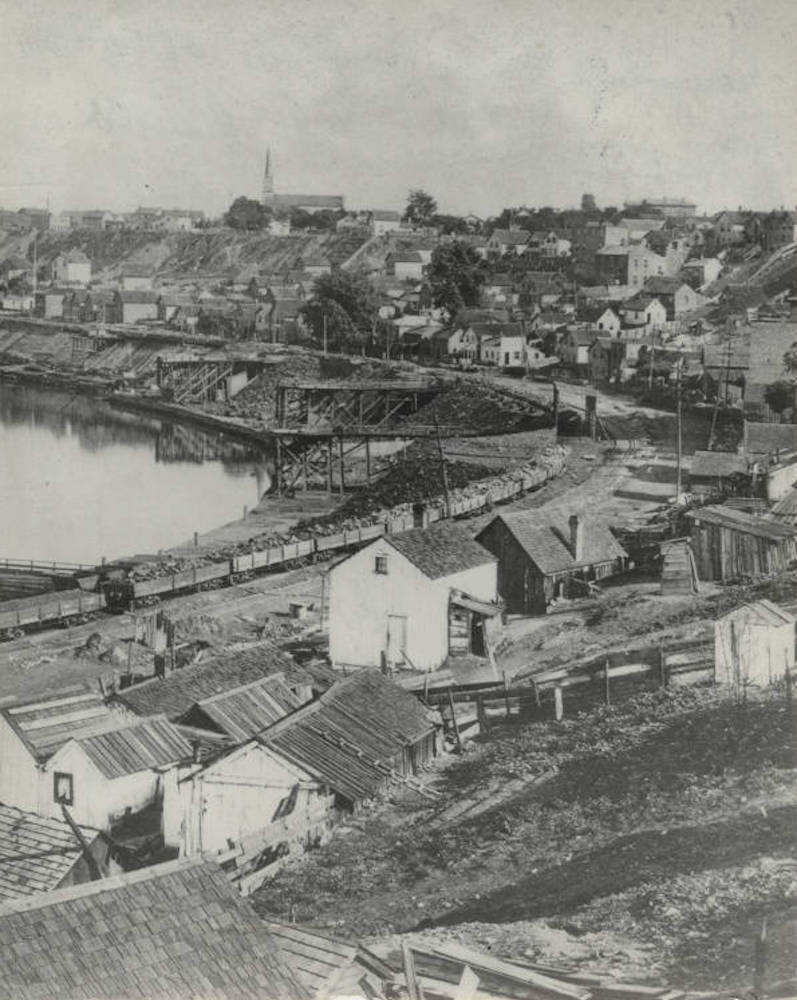
In the mid to late 1800s, Irishtown Bend was a densely populated warren of simple wooden houses and poorly built shanties. These homes were wedged on a rather unstable hillside above a bend in the river. Residents were typically employed in unskilled occupations that demanded intense physical labor and provided scanty compensation. Heads of households scratched out a living as dockworkers, canal laborers, railroad men, construction workers, and factory employees. Their meager salaries resulted in harsh living conditions, and families faced many challenges. Some homes were shoddily built, and because most were made of wood, they were susceptible to recurring fires. In addition, threats of flooding, along with the unstable condition of the hillside, produced constant stress. Factories routinely dumped toxic waste into the river, creating a squalid, unhealthy environment. Finally, overcrowding along with unsanitary conditions fostered infectious diseases such as cholera, diphtheria, and scarlet fever.
Irishtown Bend developed a reputation for poverty, crime, and disorder. Thus, residents were often met with derision and discrimination from their fellow citizens who commonly referred to them as “Shanty Irish.” When attempting to upgrade their employment at “respectable businesses,” Irish laborers routinely confronted signs that read, “No Irish Need Apply.” Nevertheless, though the odds were stacked against them, these “Shanty Irish,” with diligence and tenacity, were able to overcome these adversities. In fact, many second generation Irish families were able to relocate to more prosperous areas in Cleveland. These successful strivers came to be known as “Lace Curtain Irish.”
As time passed, more and more Irish families acquired the means to move out of Irishtown Bend. By 1900, most of them were gone and Eastern European immigrants had resettled in their place. Soon expanding industrial development began to encroach upon the area, and the neighborhood experienced substantial decline. By 1950, all that remained on the hillside were a few rickety warehouses. Thirty years later, not a single residential or commercial business remained, and Irish Bend was totally abandoned.
Redevelopment of the area did not begin until the early 1990s after archaeologists (from the Cleveland Museum of Natural History and Cleveland State University) excavated the site as a means of learning more about the history of Cleveland. Their excavation revealed house foundations, wells and outhouses, household goods, children’s toys, and ceramics, bottles, and tools. The discoveries, which provided a detailed window into the daily lives of 19th century working-class Irish immigrants, proved significant enough that the area was recognized as Irishtown Bend Archaeological District and listed on the National Register of Historic Places in 1990.
The evolution of Irishtown Bend continues today. In February 2026, the Port Authority of Cleveland completed a $65 million stabilization of the hillside of Irishtown Bend. This work had a two-fold effect. First, it prevented further erosion and a possible landslide that would block the Cuyahoga River and thus obstruct a vital shipping lane and impair regional commerce. Second, it paved the way for the development of the Irishtown Bend Park, a 25-acre riverfront park that will preserve and illuminate the history of Cleveland’s Irish immigrants.
This park, designed by the Cleveland Metroparks, was long in the making and faced many hurdles. One obstacle involved the acquisition of private land. The Cleveland-Cuyahoga Port Authority attempted to obtain the land through eminent domain, but the owners (Tony and Bobby George, who held only 0.41 acre of the property) filed a lawsuit. The resulting court procedures delayed the project almost two years before the suit was finally settled. The settlement granted a $1.25 million payment to the Georges along with the first option to lease a planned restaurant in the park.
Another concern was the considerable public cost of the project. However, officials convincingly argued that doing nothing to the unstable hillside would cost far more should the embankment slide into the river. Potential gentrification was another concern. Some longtime community members feared that a waterfront park would raise property values and rents, thus making the nearby neighborhoods less affordable. Nevertheless, the majority of residents concluded the benefits of the park would likely outweigh the risks of possible gentrification.
After surmounting these challenges, the Metroparks began construction of public infrastructure and parkspace. Their master plan for the park, to be completed in three phases, includes a hiking/biking trail, a riverfront promenade and boardwalk, a community amphitheater, and cultural and historical elements. Phase One, the stabilization of the hillside, was completed this year, after which the Port Authority transferred the site to the Metroparks, Phase Two, currently underway, includes the hiking/biking trail and a treelined, 32-foot-wide promenade. The trail, which will link the 101 mile Ohio Erie Canal Towpath Trail to Wendy Park and Lake Erie, and as well as the promenade, are expected to be completed by summer 2027.
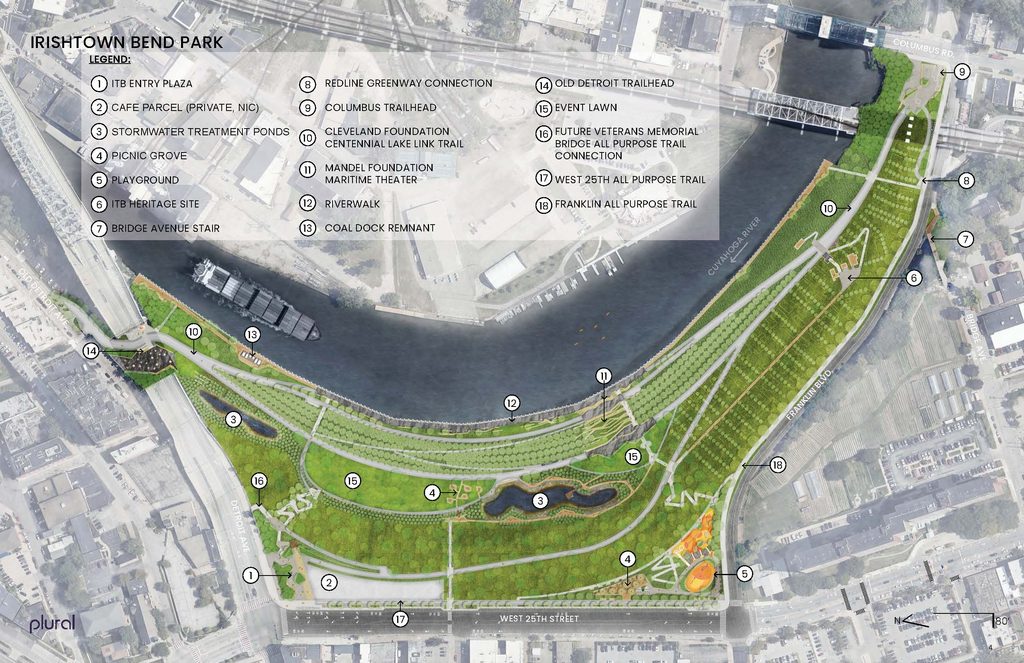
Phase Three, scheduled for completion in 2029, will finalize construction of the park. It will include the Great Lawn, situated in the center of the park, and functioning as a center for community events and festivals. Below this, an amphitheater will tier down toward the river bank, providing seating for viewing river traffic, outdoor movies, and live performances. Crooked River Play Space will be positioned near the main entry plaza of the park, and it will feature dynamic playgrounds and sport courts. The bulk of the hillside itself will be reserved for elements of history, culture, and heritage, which will honor the 19th century Irishtown settlement. Sculptural front doors, engraved with original addresses, will dot the landscape. Thresholds of original houses will reveal the density of building construction and pinpoint the specific locations of various structures. Preserved archaeological remnants will be displayed throughout the grounds and will reveal and illuminate the daily lives of the immigrants.
The unfinished business of Irishtown Bend Park will soon be completed. Soon, there will be much to see and do at this extraordinary park. Clevelanders eagerly await its opening. Until then, as we envision the Metropark’s future plans, we can anticipate stepping back in time, when historic Irishtown Bend invites us to feel the presence of the past.